


The lockdowns that started since 2020 have caused an explosion in families raising backyard chickens.
About 11 million U.S. households kept backyard chickens in 2025, up from 5.8 million in 2018, according to the American Pet Products Association (via Axios).
People are not just raising more chickens for scrambled eggs and pets. The consumption of chicken meat and eggs keeps growing too, and the U.S. produced 105 billion eggs in 2025, according to the USDA, even after bird flu cut the laying flock.
The reasons for this are many. Egg consumption has risen over 16% in the United States over the last 20 years.
Raising hens for eggs provides food security should the grocery store shelves go empty again. Some want to raise hens for eggs others want chickens for meat.
Raising a backyard flock is a great hobby when you are cooped up at home all day every day with nothing to do. They teach young children where their food comes from and provide hours of family entertainment.
Depending on the breed of chickens you raise you can expect 200-300 eggs per hen each year.
Let’s dive into some of the more surprising research on backyard chicken statistics and general chicken statistics.
Key numbers at a glance
| Statistic | Figure | Source |
|---|---|---|
| U.S. households keeping backyard chickens (2025) | about 11 million (5.8 million in 2018) | American Pet Products Association via Axios |
| Largest U.S. cities allowing backyard chickens | 93% of the 150 most populated | Research study (SAGE Journals) |
| Eggs per hen per year | 200-300 | Farm Aid |
| Backyard flocks with or planning a rooster | 58% | Heritage Acres Market |
| Backyard coops with no winter heating | Almost 80% | Heritage Acres Market |
| Rise in U.S. egg consumption over 20 years | over 16% | United Egg Producers |
| Iowa egg production (2025) | 13.5 billion eggs, about 13% of U.S. output | USDA NASS |
| U.S. eggs produced (2025) | 105 billion (down 4% from 2024) | USDA NASS |
| Cage-free share of U.S. laying hens (March 2026) | 46.4% (146.4 million hens) | USDA AMS Egg Markets Overview |
| Average price, dozen Grade A large eggs (August 2026) | $2.27 (record $6.23 in March 2025) | Bureau of Labor Statistics |
| U.S. commercial poultry lost to bird flu since 2022 | more than 200 million birds | WATTPoultry (March 2026) |
| U.S. poultry meat consumption per capita (2020) | 51.0 kg | OECD Data 2020 |
| Salmonella infections in the U.S. each year | 1.35 million | CDC |
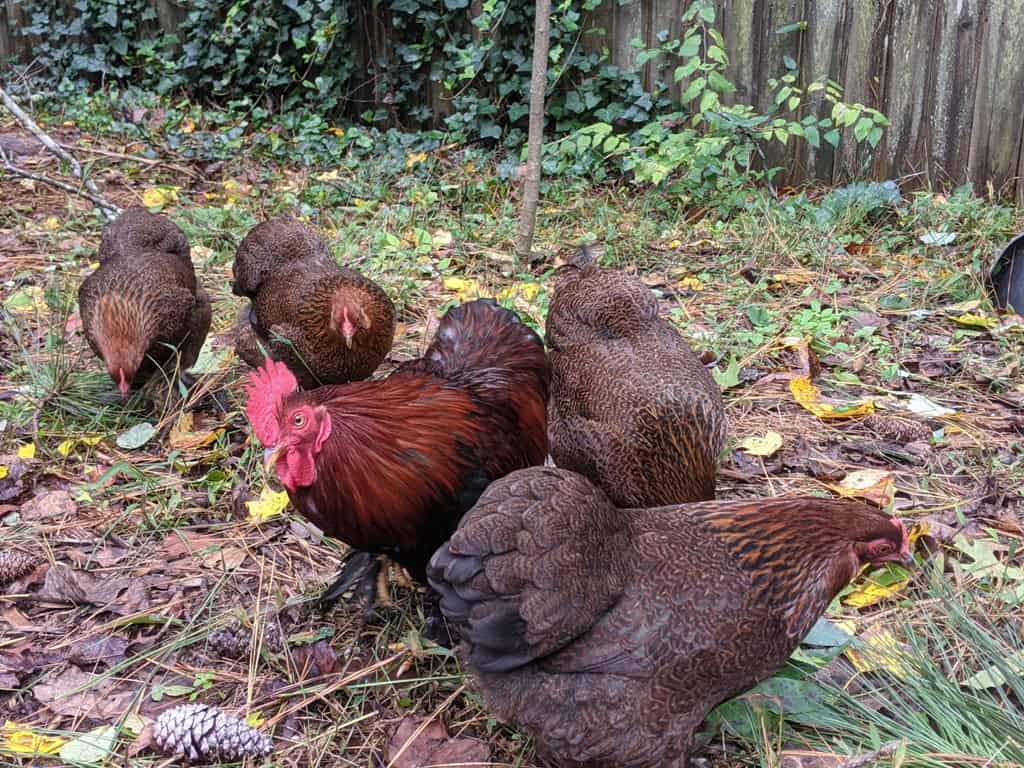
How Many Backyard Chickens Are There In the US?
The American Pet Products Association estimates that about 11 million U.S. households kept backyard chickens in 2025, nearly double the 5.8 million in 2018. About 8 million of those households treat their hens as pets, according to the same APPA figures reported by Axios.
The number of households raising chickens in the U.S. keeps growing, especially when egg prices spike.
With backyard chicken statistics like these, it’s clear the having a backyard flock is becoming more popular each year.

Backyard Chicken Statistics Explored
Backyard chicken keeping has primarily increased due to the COVID-19 outbreak, but there are other reasons as well. There is a growing desire to become more self-sufficient and to be aware of where their food comes from.
According to a research study, 93% of the 150 most populated U.S. cities allow people to keep backyard chickens in some capacity. How many chickens you can have depends on local city ordinances.
A survey by the Heritage Acres Market found the following.
- 58% of flocks have or plan to have a rooster
- Pooping in nest boxes is the most common chicken issue
- Fresh eggs are the main reason people raise backyard chickens
- Almost 80% of chicken coops have no heating during the winter
- The most popular breed is the Easter Egger amount backyard chicken keepers
- Hawks are the most common predator for backyard flock owners
- Backyard chicken keepers favorite egg color is blue
- About 11 million U.S. households kept backyard chickens in 2025, up from 5.8 million in 2018, according to the American Pet Products Association.
- 93% of the 150 most populated U.S. cities permit backyard chickens in some form, according to a study in Public Health Reports.
- The average U.S. price for a dozen Grade A large eggs hit $4.15 in December 2024, a 65% increase from $2.51 in December 2023, according to Bureau of Labor Statistics data.
- Egg prices set a record of $6.23 a dozen in March 2025, according to the same BLS series, which pushed many more families toward their own hens. Prices have since fallen back to $2.27 a dozen in August 2026, and the USDA expects egg prices to drop about 29% across 2026.
- About 8 million U.S. households treat their hens as pets, according to the American Pet Products Association.
Which States have the Most Chickens?
According to Statista Iowa has the most chickens with 72.58 million, Indiana has 44 Million and Ohio has 43 million chickens.
How many eggs does the U.S. produce each year?
According to the USDA, the United States produced 105 billion eggs in 2025, down 4% from 2024 as bird flu outbreaks cut the laying flock. Production is recovering in 2026: August 2026 output was up 5% from a year earlier, with 384 million laying hens on September 1, 2026. The top producing egg states are Iowa, Indiana, and Ohio.

Which state ranks first in egg production?
Iowa ranks first in egg production with 13.5 billion eggs in 2025, about 13% of the U.S. total, followed by Ohio at 11.1 billion and Indiana at 10.7 billion, according to the USDA.
Cage-free hens made up 46.4% of the U.S. table egg flock in March 2026, about 146.4 million hens, according to the USDA AMS Egg Markets Overview. That is up from about 38% in June 2023, per the USDA Economic Research Service.
The table below states the year egg production figures.
| Top 5 Egg Producing States | Number of Eggs Per Year |
|---|---|
| 1. Iowa | 13.5 Billion |
| 2. Ohio | 11.1 Billion |
| 3. Indiana | 10.7 Billion |
| 4. Pennsylvania | 8.0 Billion |
| 5. Texas | 6.2 Billion |
Which States Produce The Most Chickens?
Georgia, Arkansas, Alabama, North Carolina and Mississippi produce the most broiler chickens raised for meat, according to the National Chicken Council. The U.S. produced almost 9.4 billion broilers in 2025, weighing over 62 billion pounds.
Georgia produces the most broiler chickens of any state, about 1.32 billion in 2025, according to the USDA. All U.S. poultry production was worth $81.7 billion in 2025.
About 20,000 family farms raise these broiler chickens under contract. Feeding these chickens takes a lot of corn: the National Chicken Council says 34.4 million tons of corn went into broiler and breeder feed in 2025.
Another 13.3 million tons of soybean meal went into that feed in 2025.
The U.S. has one of the largest broiler chicken industries in the world, and about 14 percent of production is exported to more than 100 countries.
That works out to about 25 million broiler chickens a day. Americans ate 104.3 pounds of chicken per person in 2025, according to the National Chicken Council.
The World is Eating More Chicken.
OECD-FAO Agricultural Outlook Report states that the consumption of poultry meat is projected to increase globally to 145 Million tons into the year 2029, Poultry is expected to be 50% of the meat consumed during this time throughout the world.
Robust growth rates will be because of consumption increases in China and India. Additionally, other Asian countries are starting to consume less pork and eat more chicken.

What Country Eats The Most Chicken?
| Top 10 poultry meat consumers 2020 | (kg/per capita consumption) |
| 1. Israel | 64.4 |
| 2. United States | 51.0 |
| 3. Malaysia | 49.3 |
| 4. Peru | 46.0 |
| 5. Australia | 43.8 |
| 6. Brazil | 40.8 |
| 7. New Zealand | 40.1 |
| 8. Argentina | 38.1 |
| 9. Chile | 37.1 |
| 10. Canada | 35.5 |
According to industry statistics from the OECD, the United States is the second-largest consumer of poultry meat at 51.0 kg/per capita and the country of Israel is the largest per capita at 64.4kg

How Many Chickens Are In The World?
According to Statista there are over 23.7 billion chickens in the world at any given time. The country with the most chickens is mainland China with over 5.27 Billion Chickens.
The United States had the 3rd most overall with 504.5 million chickens. 65 billion chickens are consumed by the world each year.
Biosecurity In Chickens
It doesn’t matter if your raising chickens in your backyard or consuming them at restaurants. Health safety is paramount where your raising backyard chickens or on a commercial chicken farm.
Proper procedures must people followed to keep flocks and humans healthy.
The CDC estimates 1.35 million infections, 26,500 hospitalizations, and 420 deaths are caused each year by Salmonella bacteria.
Over 1.2 million chickens died or were euthanized in California due to Newcastle’s disease from March 2018 to February 2020. Often the chickens show no signs of the disease before dying and there is no cure once chickens contract the deadly illness.
The disease is believed to have spread from hens owned by backyard chicken owners into commercial flocks where the disease continued to spread.
This is why biosecurity is so important to prevent the spread of disease-causing organisms in chickens.
Conclusion
Whether you are raising chickens as a hobby for eggs or consuming them for meat they are an intricate part of our daily lives and will continue to do so for centuries to come.
Frequently Asked Questions
How many U.S. households raise backyard chickens?
About 11 million U.S. households kept backyard chickens in 2025, according to the American Pet Products Association. That is nearly double the 5.8 million households in 2018. About 8 million of those households treat their hens as pets, and record egg prices in 2025 pushed even more families to start a flock.
Are backyard chickens allowed in most U.S. cities?
Yes. According to a published research study, 93% of the 150 most populated U.S. cities allow people to keep backyard chickens in some capacity. How many chickens you can keep depends on local city ordinances, so check your city rules before you buy chicks or build a coop.
How many eggs does a backyard hen lay per year?
A backyard hen lays about 200-300 eggs per year depending on her breed, according to Farm Aid. A Heritage Acres Market survey found fresh eggs are the main reason people raise backyard chickens, and the Easter Egger is the most popular breed among backyard keepers.
Which U.S. state produces the most eggs?
Iowa produces the most eggs in the United States, with 13.5 billion eggs in 2025, about 13% of U.S. production, according to the USDA. Ohio was second at 11.1 billion and Indiana third at 10.7 billion, followed by Pennsylvania and Texas. Total U.S. production was 105 billion eggs in 2025.
Which country eats the most chicken?
Israel eats the most chicken per person, at 64.4 kg of poultry meat per capita, according to OECD data for 2020. The United States ranks second at 51.0 kg per capita, followed by Malaysia at 49.3 kg and Peru at 46.0 kg.
How many chickens are there in the world?
There are over 23.7 billion chickens in the world at any given time, according to Statista. Mainland China has the most, with over 5.27 billion chickens, and the United States ranks third with 504.5 million. Around 65 billion chickens are consumed worldwide each year, as reported by The New York Times.


